

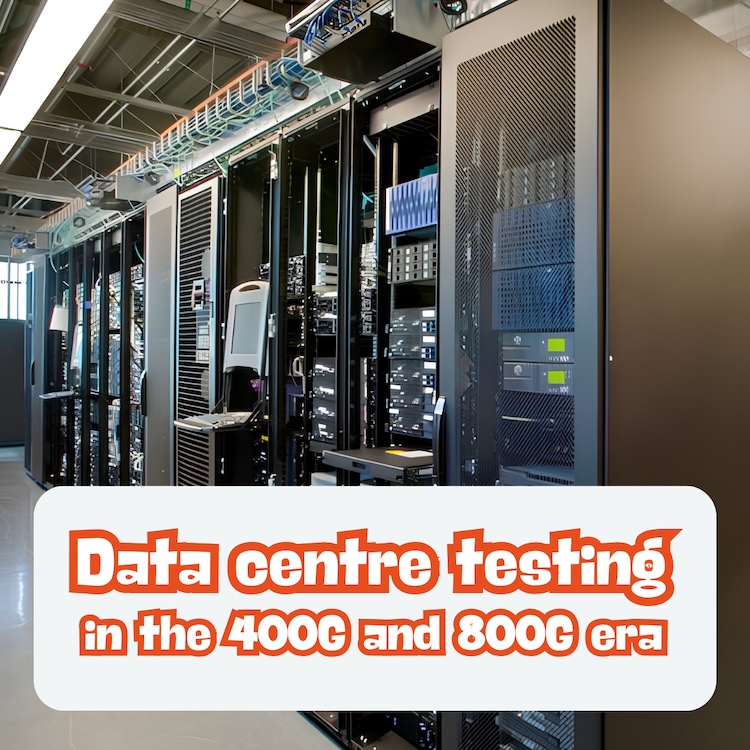
Data centre infrastructure is changing faster than at any point in the past decade. The combination of cloud growth, AI training workloads, and continuous demand for lower latency has pushed hyperscale operators to roll out 400G links across their fabrics, with 800G now being deployed at scale and 1.6T not far behind. Each step up in line rate brings tighter optical budgets, tighter loss requirements, and new connector and fibre technologies that the test workflow has to keep up with.
For installers, NOC engineers, and maintenance teams working across hyperscale and enterprise environments, the test toolset has changed. An OTDR and a power meter are still useful, but they are no longer the whole story. CD/PMD/AP analysis, ribbon splicing for high fibre count cables, MPO/MTP inspection at 12 and 24 fibres, DWDM channel verification, and bi-directional OTDR measurements are now part of the day-to-day work in a modern data centre.
This article walks through the technologies driving the change, and what they mean for testing on site.
The shift to 400G, 800G, and the hyperscale fabric
Hyperscale data centres are designed around horizontal scale: tens of thousands of servers connected by leaf-and-spine fabrics that move east-west traffic between racks. As GPU clusters for AI training have moved into these environments, per-link bandwidth has had to climb to keep up. 400G is now the baseline for new spine deployments, 800G is being rolled out for AI and machine learning fabrics, and the industry is already validating 1.6T optics for the next deployment cycle.
Each of these speeds depends on a combination of higher-order modulation (PAM4 instead of NRZ), wider parallel optics, or coherent technology, and each one tightens the optical link budget. Insertion loss that was acceptable at 10G or 100G can now push a 400G or 800G link out of spec. That is why every patch, every splice, and every connector face needs to be verified against the published loss budget for the specific optic in use, not against a generic “good enough” threshold.
For test teams, the practical implication is straightforward. Loss measurements need to be made with calibrated optical loss test sets, OTDR traces need to be analysed against the actual optic in use, and end faces have to be inspected before every connection. Once the physical layer passes, 400G/800G transport testers take over for service activation, BERT, and RFC 2544 or Y.1564 verification of the live link.
Higher fibre counts and the rise of MPO/MTP, SN, and CS connectors
400G and 800G optics rely heavily on parallel fibre. A 400G-DR4 transceiver uses four pairs of single-mode fibre. A 400G-SR8 or 800G-SR8 uses eight pairs of multimode. To support these in a structured cabling system, MPO and MTP connectors have become the default choice, with 12-fibre and 24-fibre variants in regular use and higher counts emerging.
MPO and MTP are not the end of the story. Two newer connector types, SN and CS, are being adopted in switch and transceiver applications where space is tight and per-port density matters. Both are very small form factor (VSFF) connectors, designed to break out parallel optics into individual duplex links at the front panel. This is particularly relevant for 400G-DR4 and 800G-DR8 deployments where the line card needs to expose individual fibre pairs to multiple destinations.
For test teams, this changes the inspection and cleaning workflow. A single MPO-12 ferrule has twelve fibre end faces, all of which need to be clean and undamaged before connection. SN and CS introduce smaller geometries that require compatible inspection tips. Fibre inspection kits for data centre work need to cover this full range, including MPO/MTP automated pass-fail probes and the newer VSFF tips.
Ribbon splicing for high fibre count cables
The cabling that feeds these connectors has also changed. Inter-rack and inter-row backbones in modern data centres routinely use 144, 288, 432, or even 1728-fibre cables built from ribbon fibre. Splicing these efficiently is not practical with single-fibre fusion splicing. A 12-fibre ribbon takes seconds to splice on a ribbon splicer, but several minutes if you do it one fibre at a time.
Modern ribbon splicers from Fujikura and Sumitomo can handle 12- to 16-fibre ribbons in a single fusion cycle, with mass cleaving and proof testing built into the workflow. For data centre installers working under tight commissioning deadlines, this is the difference between meeting a cutover window and falling behind. It is also the difference between consistent, low-loss splices across all fibres in a ribbon, and a mix of good and marginal splices that show up later as link errors.
Ribbon splicing also requires its own preparation discipline: ribbon strippers, ribbon cleavers, and clean working conditions. Treating it as a slightly different version of single-fibre splicing is one of the most common reasons projects run into rework on site.
DWDM and the evolution of data centre interconnects (DCI)
Inside a single data centre, links are short and almost always single-wavelength. Between data centres, the situation is different. Data centre interconnects (DCI) typically span tens to hundreds of kilometres, and operators get the most out of those expensive fibre routes by running DWDM. A single fibre pair can carry 80 channels of 100G, 400G, or even 800G coherent traffic over a C-band grid.
For installers and maintenance teams, this introduces a different test workflow. Each DWDM channel has to be verified for power, wavelength accuracy, and optical signal-to-noise ratio (OSNR), which is the job of an optical spectrum analyser (OSA). Channel power needs to be balanced across the grid, and amplifier output needs to be confirmed at the launch point of each span.
Coherent 400G and 800G optics are more tolerant of dispersion and OSNR than older direct-detect systems, but they are still bound by the laws of physics on long spans. That is why DCI commissioning typically involves both an OSA pass for channel verification and a separate dispersion measurement for the underlying fibre.
Why optical dispersion matters at 400G and beyond (CD/PMD/AP)
On any fibre route longer than about 40 km, three dispersion effects start to limit performance: chromatic dispersion (CD), polarisation mode dispersion (PMD), and the attenuation profile (AP) of the fibre across the band. At 10G these were rarely a concern. At 100G coherent they became manageable. At 400G and 800G coherent on long DCI spans, they have to be characterised before service.
A CD/PMD/AP analyser measures all three in a single test. The CD result tells the engineer how much pulse spreading per nanometre of wavelength they are dealing with, which feeds directly into the dispersion compensation budget of the line system. PMD reveals random birefringence in the fibre, which can cause uncorrectable errors in coherent receivers if it exceeds a few picoseconds. The AP measurement shows attenuation across the C-band, which matters for DWDM systems that need flat performance across all channels.
These measurements are not optional on long DCI spans. They are part of the commissioning record that proves the fibre is fit for the intended line rate, and they need to be repeated whenever a span is repaired or rerouted.
New fibre types: Multi-Core Fibre (MCF) and Hollow Core Fibre (HCF)
Two emerging fibre technologies are starting to appear in real deployments, and both are worth understanding even if they are not yet mainstream.
Multi-Core Fibre (MCF) places several light-guiding cores inside a single cladding, typically four or seven cores in current research and early commercial deployments. The result is a single physical fibre that carries multiple independent signals, multiplying capacity per physical fibre count. MCF is being trialled in submarine cables and in research-led hyperscale environments where physical space for fibre is constrained.
Hollow Core Fibre (HCF) takes a different approach. Instead of guiding light through a glass core, it guides light through a hollow air-filled structure. Because light travels roughly thirty percent faster in air than in glass, HCF reduces propagation delay over a given distance, which is valuable for latency-sensitive applications such as high-frequency trading and AI inter-data-centre links. Microsoft and several carriers have publicly deployed HCF on selected routes.
For test teams, both fibre types require some adaptation. The wavelength behaviour, mode field diameter, and loss characteristics are different from standard G.652 single-mode fibre, and not all OTDRs and OLTS handle them equally well. As deployments expand, the test workflow will need to expand with them.
Bi-Directional OTDR testing for accurate fibre characterisation
OTDR testing has been a fixture of fibre commissioning for decades, but the way it is done in a modern data centre has evolved. The single most important refinement is bi-directional testing.
A standard OTDR fires pulses from one end of the fibre and infers loss along the link from backscatter. The problem is that any splice or connector between two fibres with slightly different mode field diameters can show up as a “gain” event on a one-way trace, which is physically impossible and obscures the real splice loss. A Bi-Directional OTDR measurement, which involves testing the same link from both ends and averaging the two traces, removes that asymmetry and gives the true loss of every event on the span.
For 400G and 800G commissioning, where every tenth of a dB matters, bi-directional OTDR is no longer a nice-to-have. It is the standard of care for any inter-rack, inter-row, or DCI fibre link going into production. Modern OTDRs from EXFO, VIAVI, and Anritsu support bi-directional analysis directly in their software. For ultra-long DCI spans, coherent OTDRs such as the Anritsu MW90010B extend the technique to hundreds of kilometres.
How RentalTec supports data centre teams
The combination of high line rates, dense connector counts, and new fibre types means that test inventory in a data centre project tends to grow quickly. Most teams need a CD/PMD/AP analyser, a dual-wavelength or coherent OTDR, an OSA, MPO inspection probes, a ribbon splicer, and a multi-fibre OLTS for the duration of a commissioning project, and far less of that equipment for routine maintenance afterwards.
Renting that test inventory rather than buying it is the model most operators land on for that reason. RentalTec stocks all of the categories above across our offices in Belgium, Germany, the United Kingdom, and France, with local stock and local-language support. Whether you need a Fujikura FSM-90R for a single ribbon splicing campaign, a CD/PMD/AP analyser for a DCI commissioning project, or a fleet of MPO inspection probes for an AI fabric build, we can ship from the closest location and have you set up within 24 to 48 hours.
For longer projects, Rent2Buy and leasing provide a way to keep instruments in your team’s hands without the CAPEX hit. For repairs and calibration during a rental period, our authorised service centre status means we can handle the work directly rather than shipping it out to a third party.If you are scoping a 400G or 800G data centre rollout and want to talk through the test plan, our team is happy to help.
FAQ
What test equipment is needed for a 400G or 800G data centre rollout?
A typical commissioning kit for 400G and 800G fibre work includes an OTDR capable of bi-directional analysis, a CD/PMD/AP analyser for any DCI span over about 40 km, an optical spectrum analyser for DWDM channel verification, MPO and VSFF fibre inspection probes, a multi-fibre OLTS, and a ribbon splicer for high fibre count cabling.
Why is bi-directional OTDR testing important for hyperscale data centres?
Single-direction OTDR traces can show false “gain” events at splices between fibres with slightly different mode field diameters, which masks the true splice loss. Bi-directional OTDR testing fires the trace from both ends and averages the result, giving an accurate per-event loss measurement. At 400G and 800G, where the optical budget is tight, this accuracy is what separates a link that passes commissioning from one that fails under load.
What are MPO/MTP, SN, and CS connectors, and why are they used in data centres?
MPO and MTP are multi-fibre push-on connectors that carry 12, 24, or more fibres in a single ferrule, which makes them the default for parallel optics like 400G-DR4 and 800G-SR8. SN and CS are very small form factor (VSFF) connectors used to break out parallel optics into individual duplex pairs at the switch front panel, where rack space and per-port density matter most.
What is Multi-Core Fibre (MCF) and where is it used?
MCF places several light-guiding cores inside a single cladding, typically four or seven, so that one physical fibre carries multiple independent signals. It is most common today in submarine cables and in research-driven hyperscale deployments where physical fibre count is constrained.
What is Hollow Core Fibre (HCF) and why does it matter for hyperscale?
HCF guides light through a hollow air-filled structure rather than a solid glass core. Light travels roughly thirty percent faster in air than in glass, which reduces propagation delay over long distances. For latency-sensitive applications such as inter-data-centre AI traffic and high-frequency trading, that latency saving is a concrete operational advantage.
Do I need to measure CD, PMD, and AP on every fibre?
Not on every fibre, but on every long span where coherent optics will run. As a rule of thumb, anything over 40 km, especially for 400G or 800G coherent DCI, should have CD/PMD/AP characterised before service. Short links inside a single data centre are not affected.
Can I rent the test equipment for a single data centre project?
Yes. RentalTec offers short-term rental, longer-term leasing, and Rent2Buy for the full data centre test toolset, including ribbon splicers, CD/PMD/AP analysers, OSAs, OTDRs, OLTS, and inspection probes. We ship from local stock in Belgium, Germany, the UK, and France, typically within 24 to 48 hours.
Interested in one of our products?
More information about this topic?
Get in touch and we will assist you and answer all your questions.