

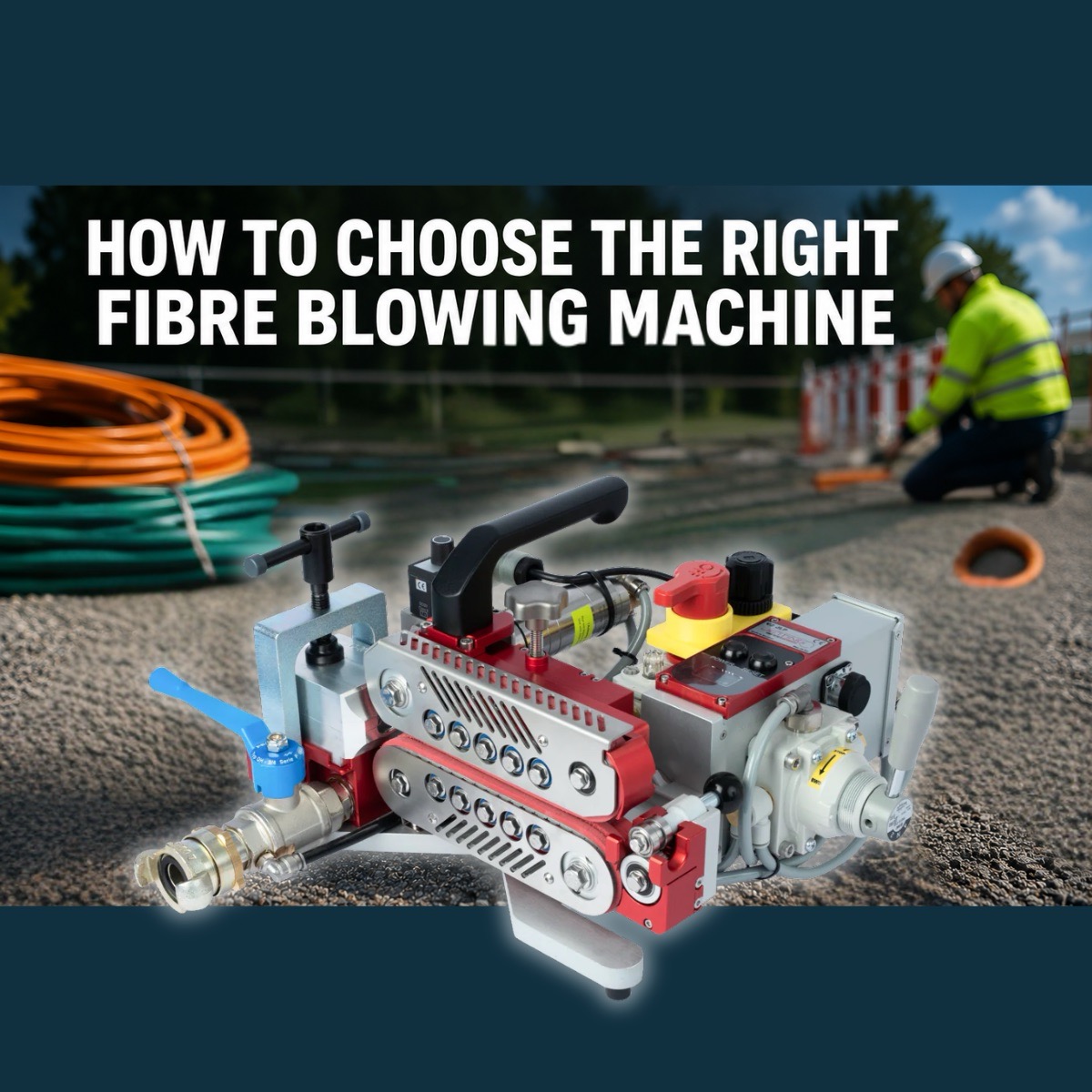
Cable jetting, also called cable blowing, is the standard way to install fibre into ducts and microducts on modern FTTx networks. Instead of pulling a cable and risking damage, a blowing machine combines compressed air with a controlled mechanical drive to move the cable gently through the duct over long distances. The catch is that no single machine suits every job. The right choice depends on the cable, the duct, and the distance you need to cover. This guide walks through how to match the machine to the job, using the Jetting range we rent at RentalTec: the handheld TriggAIR and the V0, V2, V3, and V4.
How cable blowing works
A blowing machine seals around the duct and drives the cable forward with a motorised wheel while compressed air flows down the duct. The airflow creates drag along the length of the cable, which spreads the installation force evenly and lets you reach distances that pulling could never achieve, all while keeping the cable within its bend and tension limits. Micro cables go into small microducts on the access and last-mile sections of the network, while larger mini cables run through bigger ducts on the backbone. Subducting, where a smaller duct is blown into a larger one, extends the same principle to the longest runs.
Three questions that decide your machine
Before you pick a machine, answer three things:
- What cable are you installing? Micro cable or mini cable, and at what fibre count?
- How far do you need to go? A last-mile drop is a very different job from a multi-kilometre backbone.
- Which part of the network, and which duct? Last-mile or drop level (NE4), distribution and backbone (NE3), or subducting into an existing duct?
With those answers, the choice becomes straightforward.
Matching the machine to the job
The table below maps the most common scenarios to the Jetting machine that fits.
| Application | Cable | Network level | Max distance | Machine |
|---|---|---|---|---|
| Short last-mile micro links | Micro cable | Drop / last mile | Up to 200 m | TriggAIR |
| Last-mile micro cable | Micro cable, 24-fibre | NE4 | Up to 750 m | V0 |
| Backbone mini cable | Mini cable, 95 or 144-fibre | NE3 | Up to 1.5 km | V2 or V3 |
| Subducting and long backbone | Mini cable (subducting) | Backbone | Up to 4 km | V4 |
The machines in more detail
TriggAIR (handheld): A compact, battery-powered handheld unit for blown fibre and micro/nano cables in small microducts. It is the fastest tool to set up for drop installations and short last-mile links up to around 200 m.
V0: An extremely compact, electrically operated machine for micro cable on the last mile, such as a 24-fibre micro cable up to 750 m at NE4 level. A full digital control system with softstart protects the fibre from the very start of the push.
V2 and V3: Pneumatic machines with joystick control for higher-count mini cables on the backbone (NE3), up to around 1.5 km. The V3, in particular, delivers the extra pushing force needed for heavier and armoured cables. It is also suitable for subduct installation.
V4: The machine for the longest runs and for subducting, installing mini cable on the backbone up to around 4 km.
The logger goes with the machine, every time
One rule applies to every job: the logger travels with the machine. The JetLogger documentation system records the parameters that matter (air pressure, speed, distance, and pushing force) at every metre of the run, along with GPS position, temperature, and humidity. That record is your proof that the cable went in cleanly and within specification, and on larger networks it is increasingly a contractual requirement rather than a nice-to-have. The JetLogger is built to recognised documentation standards, including the German ZTV TKNetz specification. When you rent a Jetting machine from us, plan for the logger as part of the kit rather than an afterthought.
Why rent your blowing machine from RentalTec
Few contractors need every machine in the Jetting range at once, and the machine you need for a last-mile push is not the one you need for a 4 km backbone. Renting lets you match the exact machine, from the handheld TriggAIR to the V4, to each phase of a project, with the logger included and every unit maintained and ready to work. Tell us the cable, the duct, and the distance, and we will recommend the right setup. Request a quote and we will get back to you quickly.
Interested in one of our products?
More information about this topic?
Get in touch and we will assist you and answer all your questions.