

You know that feeling when you’re trying to take a photo in low light, and no matter how steady you hold your hand, the edges just come out… fuzzy? A little blurred?
That’s basically phase noise. But for RF signals.
If you’re working in the lab or managing a production line for high-frequency comms, you already know that a “perfect” sine wave is a lie we tell physics students. In the real world, every signal has those ghostly, unwanted fluctuations in phase that smear the frequency. That’s phase noise—or “jitter” if you’re looking at it in the time domain.
And let’s be real—it’s a pain. Especially now.
With 5G pushing data rates higher and radar systems needing to see smaller objects further away, that “blur” isn’t just annoying; it’s a dealbreaker. If your phase noise is bad, your bit error rate goes up, your radar resolution drops, and suddenly that expensive system is performing like a cheap walkie-talkie.
So how do we actually measure all of this in practice, and which heavy-hitting test equipment from Rohde & Schwarz and Keysight make it happen?
The “quick and dirty” vs. the “gold standard”
Historically, measuring phase noise was… well, let’s just say it was a process.
You’ve got the Direct Spectrum Method. You hook your device under test (DUT) up to a spectrum analyser and look at the noise sidebands. It’s quick. It’s simple. But here’s the catch: if your analyser is noisier than your DUT (which happens a lot with high-end oscillators), you aren’t measuring the device—you’re measuring your own test gear. Not helpful.
Then there’s the Phase Detector Method. This compares your signal against a reference. Better, but complex.
But the real magic? Cross-Correlation.
Think of it like taking two blurry photos of the same object and laying them over each other to figure out what’s actually there. By using two independent internal reference sources and correlating the output, the uncorrelated noise of the instrument itself averages out.
The result? You can measure signals that are actually cleaner than the analyser you’re using. It used to require a rack of equipment and a PhD to set up. Now? It’s mostly just a button press.
Speaking of buttons, let’s look at the boxes that do this.
The heavyweights: Rohde & Schwarz FSWP and FSPN
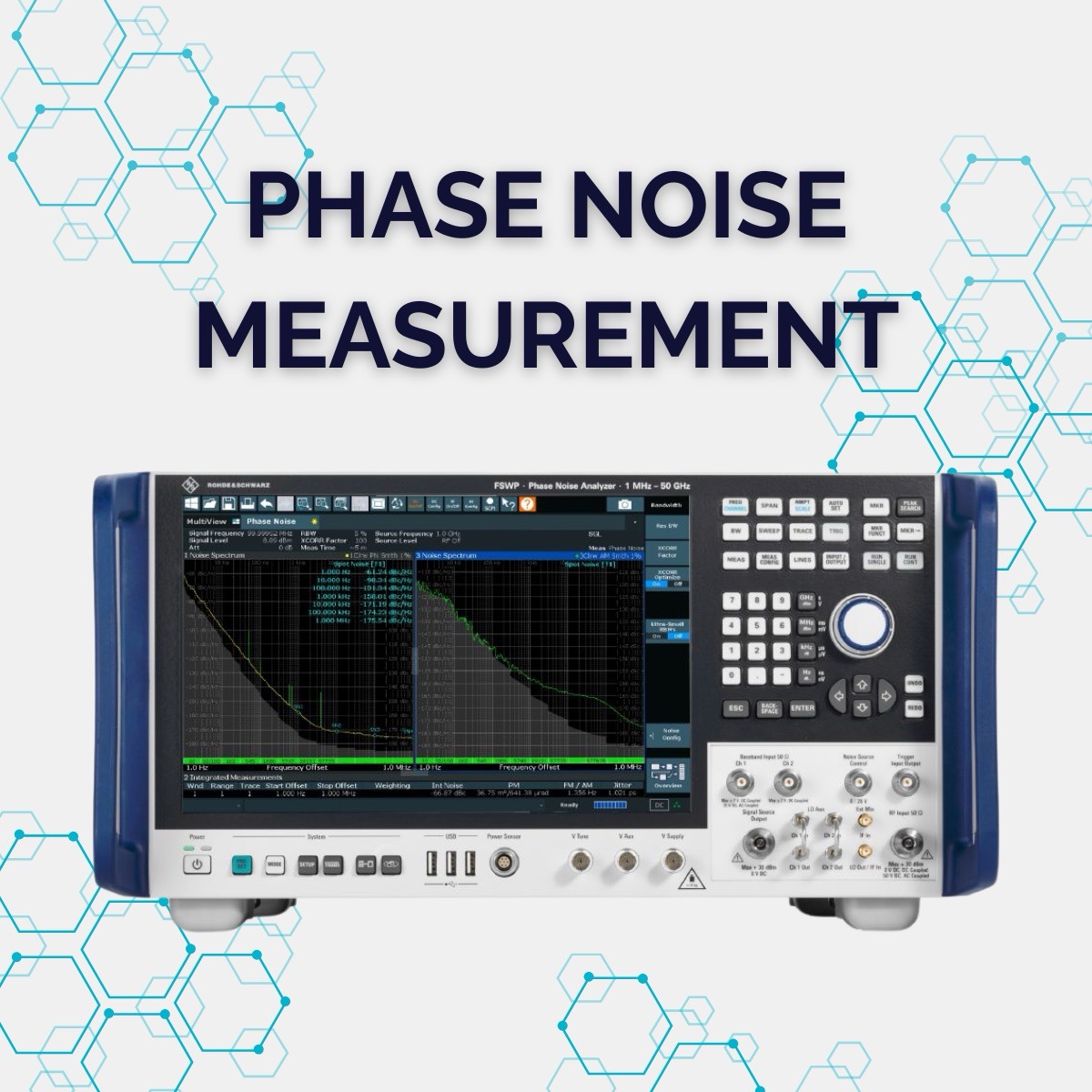
If you need the absolute best sensitivity—like, “seeing a whisper in a hurricane” sensitivity—you’re probably looking at the R&S FSWP series.
We stock the R&S FSWP26 and FSWP50 (covering up to 26.5 GHz and 50 GHz respectively). What’s cool about these is that they aren’t just phase noise analysers. They’re also full-blown high-end signal and spectrum analysers.
- Why you’d want it: It uses that cross-correlation magic we talked about to get sensitivity down to -174 dBc/Hz (at 1 GHz, 10 kHz offset).
- The killer feature: It’s fast. Like, really fast. It doesn’t need external reference sources for most jobs because the internal ones are so good. Plus, it can measure amplitude noise and phase noise at the same time.
- Pulsed signals? No problem. It can characterize pulsed radar sources at the push of a button, which used to be a nightmare of complex test setups.
But maybe you don’t need the spectrum analyser part. Maybe you just need to churn through VCO tests in production.
Enter the R&S FSPN series (we have the FSPN8, FSPN26, and FSPN50).
This creates a pure phase noise analyser and VCO tester. It trades the general-purpose spectrum analysis for speed and focused VCO characterization. It has ultra-low-noise DC sources built-in to sweep the tuning voltage of your VCO while it measures. It’s designed to be a workhorse in production environments where every second of test time costs money.
The legends: Keysight E5052B and the new SSA-X
We can’t talk about phase noise without tipping our hats to the Keysight E5052B. For years, this has been the standard Signal Source Analyser (SSA) you’d see on every bench. It’s reliable, accurate, and engineers everywhere know how to use it.
But time marches on.
If you’re looking for the next generation, check out the Keysight SSA-X series, ranging from the 8GHz E5055A, all the way up to the 54 GHz E5058A. It builds on that legacy but adds modern touches—better sensitivity, faster measurements, and a wider frequency range in a single box. It’s an all-in-one solution that just works.And for those of you who need flexibility, there’s the Keysight N9010B EXA running the N9068EM0E phase noise application. It’s a general-purpose signal analyser first, but with the app, it becomes a capable phase noise tester. It’s a great “Swiss Army Knife” option if you don’t need the extreme sensitivity of a dedicated cross-correlation box.
So, which one do you need?
It really comes down to what you’re trying to see.
- Building high-end radar or satellites? You probably need the cross-correlation power of the R&S FSWP or FSPN to see down to the thermal floor.
- Testing VCOs on a line? The R&S FSPN or Keysight E5052B are your best friends.
- General purpose troubleshooting? The Keysight N9010B might be all you need.
Here’s the thing though—these boxes are expensive. And technology moves fast. Unless you’re using them 24/7, buying one outright might hurt the budget more than the phase noise hurts your signal.
That’s where we come in. At RentalTec, we keep these units calibrated and ready to ship. You can rent the FSWP50 for that one critical project, or lease an E5055A while you ramp up a new line.
Stop guessing about your signal quality. Give us a shout, and let’s clear up that noise.
Interested in one of our products?
More information about this topic?
Get in touch and we will assist you and answer all your questions.